

Thick glass changes the meaning of patience. A schedule that works beautifully for a thin two-layer tile may be too aggressive for a slab, casting, heavy panel, or piece with uneven mass. The surface and the center do not heat or cool at the same speed.
Re-firing adds another layer. A piece may carry stress, previous heatwork, coldworked edges, repairs, inclusions, or shape changes into the next firing. The kiln is not starting with a blank slate just because the controller starts at room temperature.
This article is about the thinking pattern: slow enough to equalize, anneal for the real thickness, and treat each firing as part of the object’s history.
01 / Heat moves through mass
Thick glass needs time for the center to catch up.
In thick work, the outside of the glass can change temperature faster than the interior. That difference creates stress. The more mass, unevenness, or complexity the piece has, the more important it becomes to let temperature equalize before asking the glass to move through sensitive ranges.
A thick piece may look stable from the outside while the center is still lagging behind. This is why thick schedules often use slower ramps, longer holds, and more conservative cooling than thin work.
Thickness is not only measured at the edge. Raised areas, stacked design zones, dams, borders, cast sections, and uneven surface relief all affect how the piece absorbs and releases heat.
With thick glass, the schedule is managing internal temperature differences, not just surface appearance.
02 / Annealing is the main event
Stress relief has to match the real object.
Annealing thick work is not a token pause after the exciting part of the firing. It is the phase that gives the whole piece time to come closer to an even internal temperature before cooling continues.
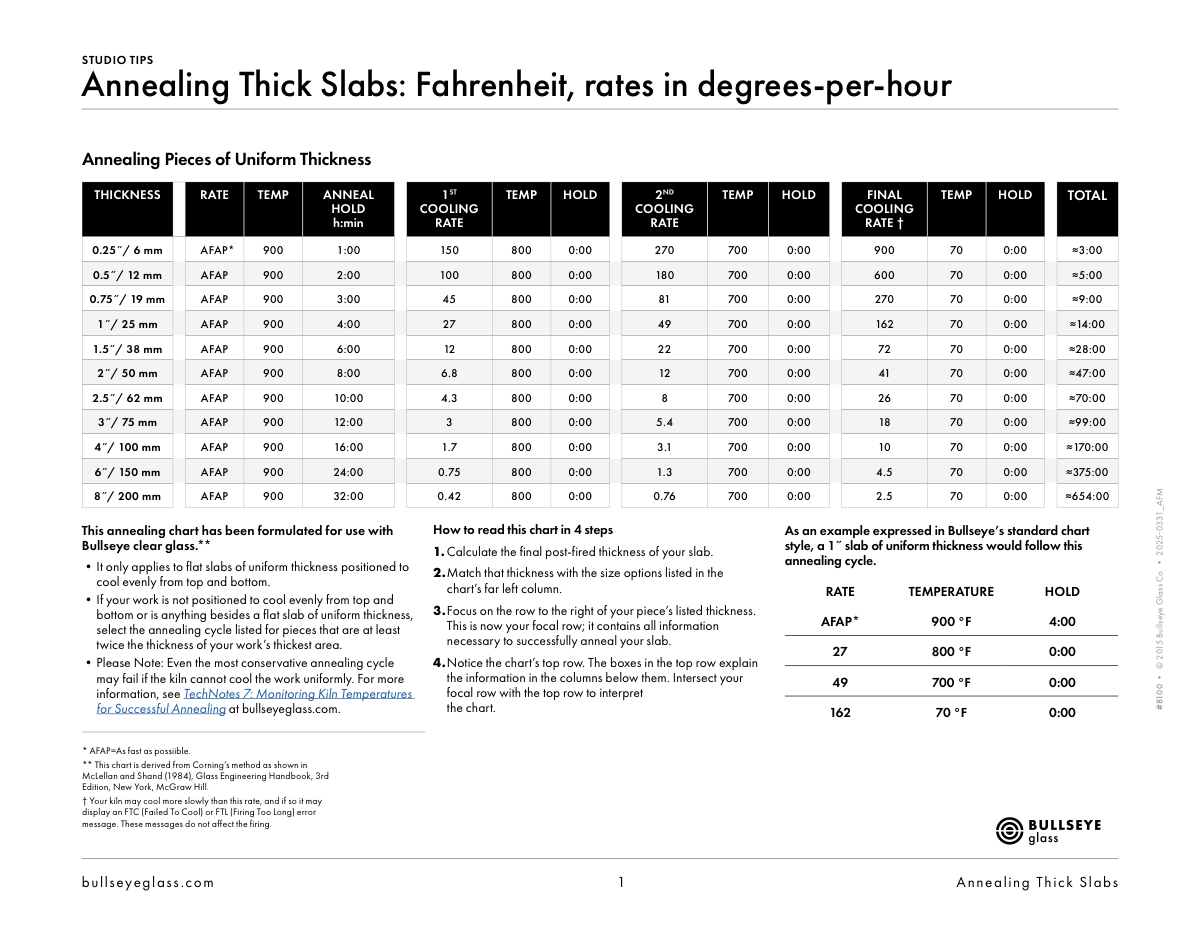
If the anneal hold is too short or the controlled cool is too fast, stress can remain even if the piece looks successful. That stress may reveal itself later during handling, coldworking, shipping, hanging, or a future firing.
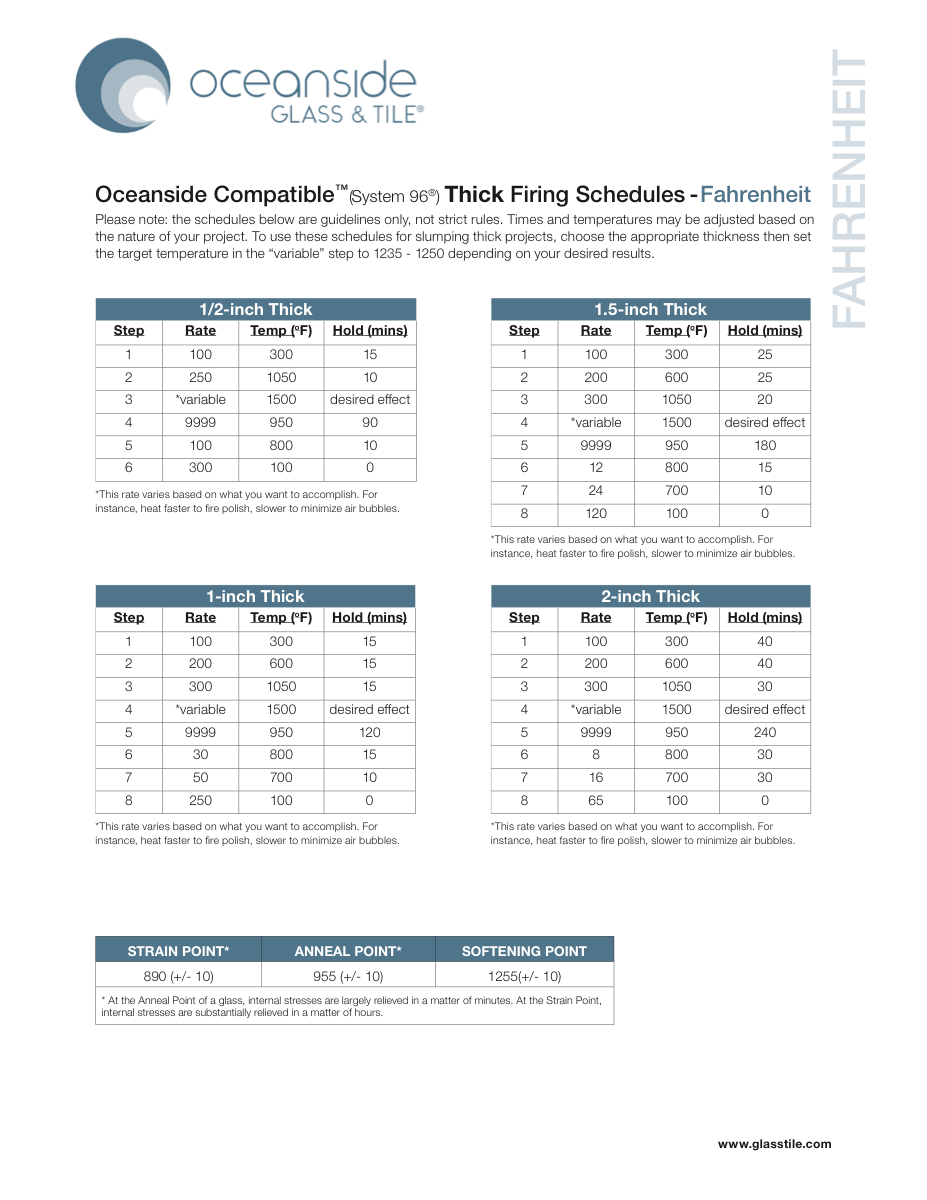
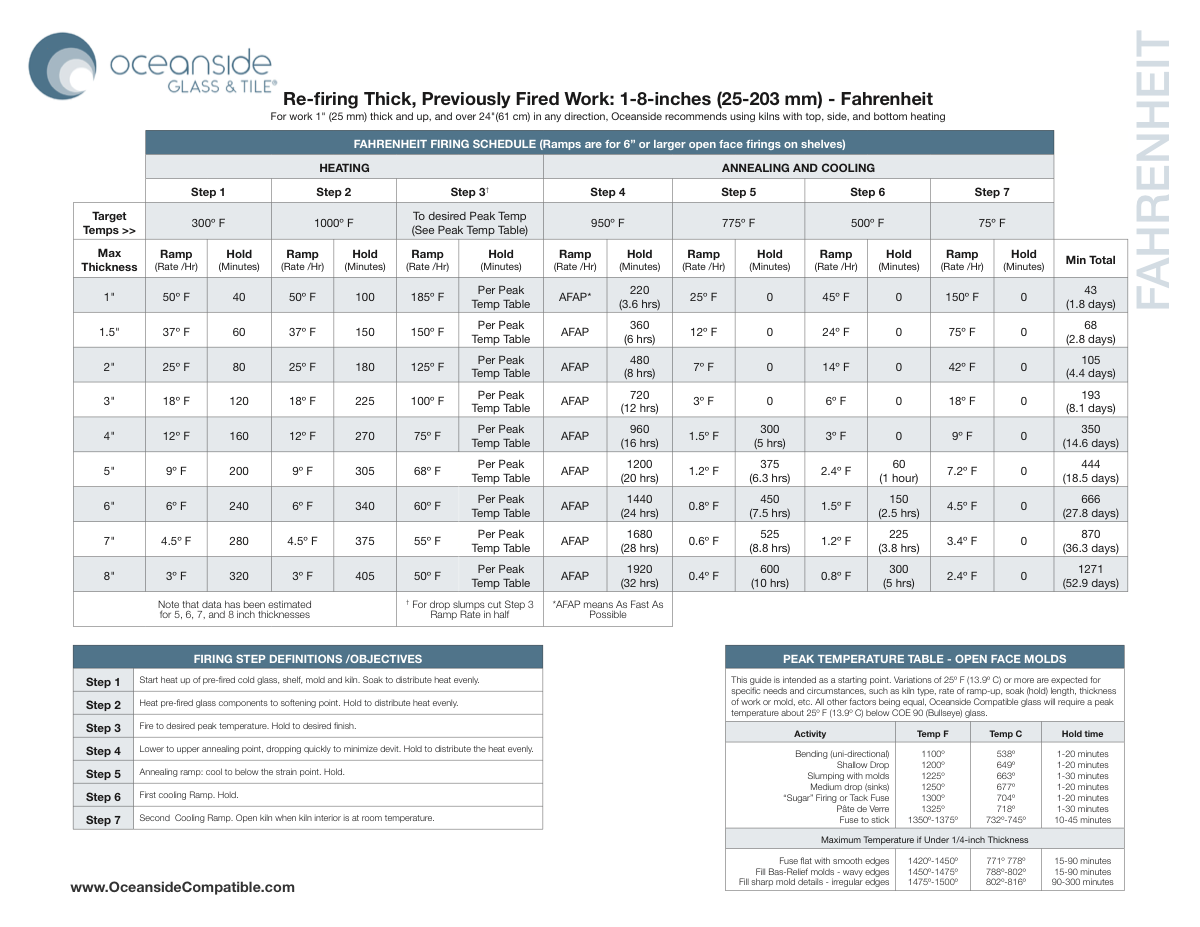
For thick pieces, manufacturer charts and technical notes are especially valuable starting points. Use them as guidance for the glass system and thickness, then adapt carefully for your kiln, form, mold, and result.
A beautiful thick piece is not finished until it has been annealed for its real mass.
03 / Re-firing history
Every firing changes what the next firing inherits.
A re-fired piece may have already been full fused, slumped, coldworked, drilled, repaired, or partially polished. Each step can change stress, edge condition, surface quality, thickness relationships, and what the next schedule should protect.
Re-firing can be useful: repairing a surface, adding elements, slumping a fused blank, correcting an under-fired result, or continuing a multi-step project. But it can also add cumulative heatwork or expose hidden stress from a previous firing.
Before re-firing, write down the piece’s history. What glass system is it? How thick is the thickest area? Was it annealed well before? Has it been coldworked? Is it going onto a mold? What is the smallest change that will accomplish the next step?
A re-fire schedule should respond to the piece’s history, not only its next goal.
04 / Testing and records
Thick work deserves better notes.
Thick glass and repeat firings are where kiln logs become genuinely protective. Record thickness, dimensions, shelf position, mold or dam setup, glass system, previous firings, schedule, observations, and final result.
Photos help. A cross-section sketch, edge photo, or note about where a crack appeared can make the next decision more focused. If a piece fails, the record can tell you whether to investigate heat-up, annealing, cooling, construction, compatibility, or coldworking.
When possible, test smaller samples before committing an important thick piece. The test may not reproduce every detail, but it can reveal how your kiln treats that glass, thickness, and schedule family.
For thick and re-fired work, good notes are part of the safety system.
Studio notes
How to use this in the studio
Use these as practical prompts for a kiln log, a studio conversation, or your next firing test.
- Anneal for the thickest and most complex part of the piece, not the average thickness.
- Write the firing history before re-firing: previous schedule, result, coldworking, and stress concerns.
- Use manufacturer thick-glass guidance as a starting point instead of improvising from thin schedules.
- If a thick piece cracks, study warm-up, anneal, controlled cool, and prior firings before changing peak temperature.
Source references
Additional resources
One practical firing tip a week
Get a short glass-studio note in your inbox.
No spam — just one useful firing, glass, or studio-practice idea from My Glass Cookbook each week.
Your email is used for MGC studio notes. Read the Privacy Policy.