
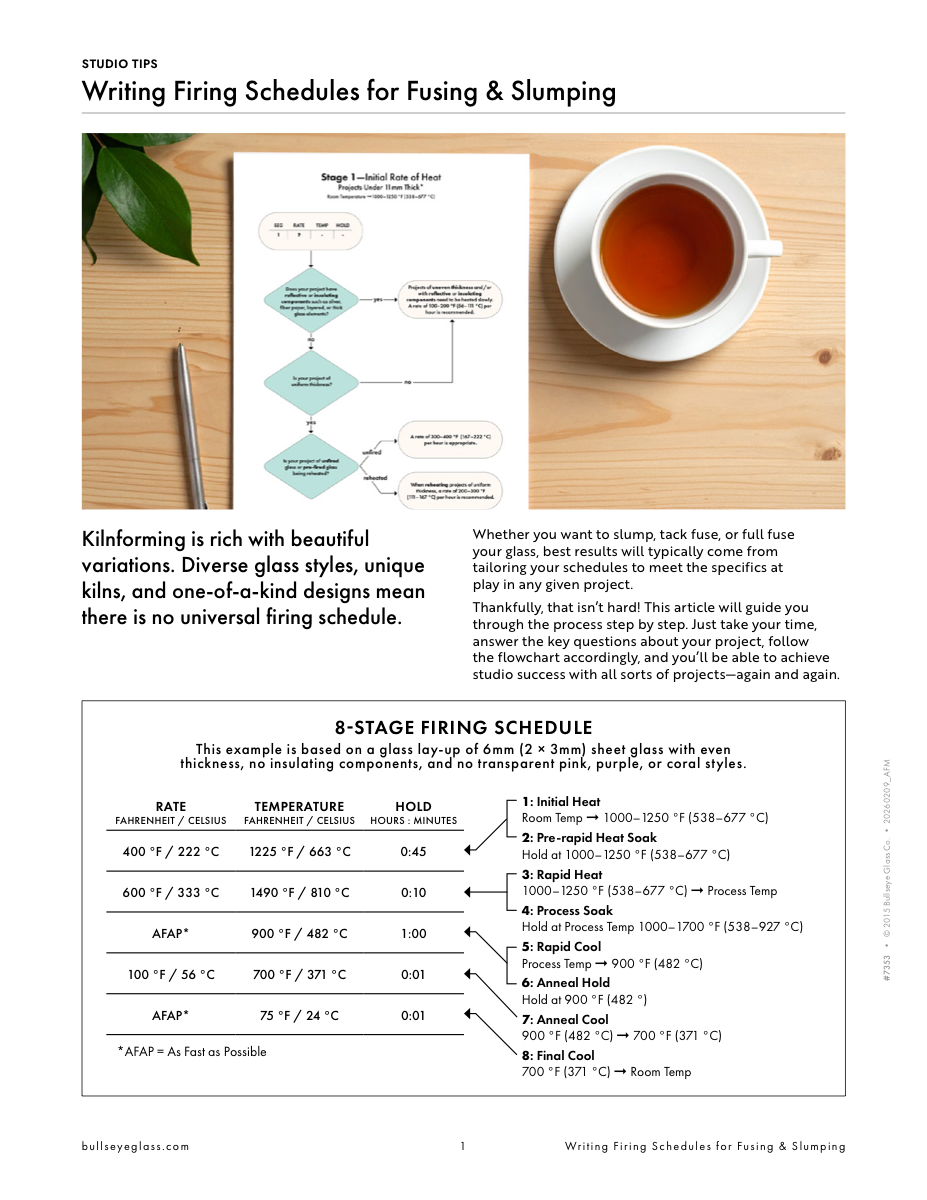
If “kiln schedule” is the whole map, rate, target, and hold are the grammar. They are the repeated building blocks that tell the controller what to do segment by segment.
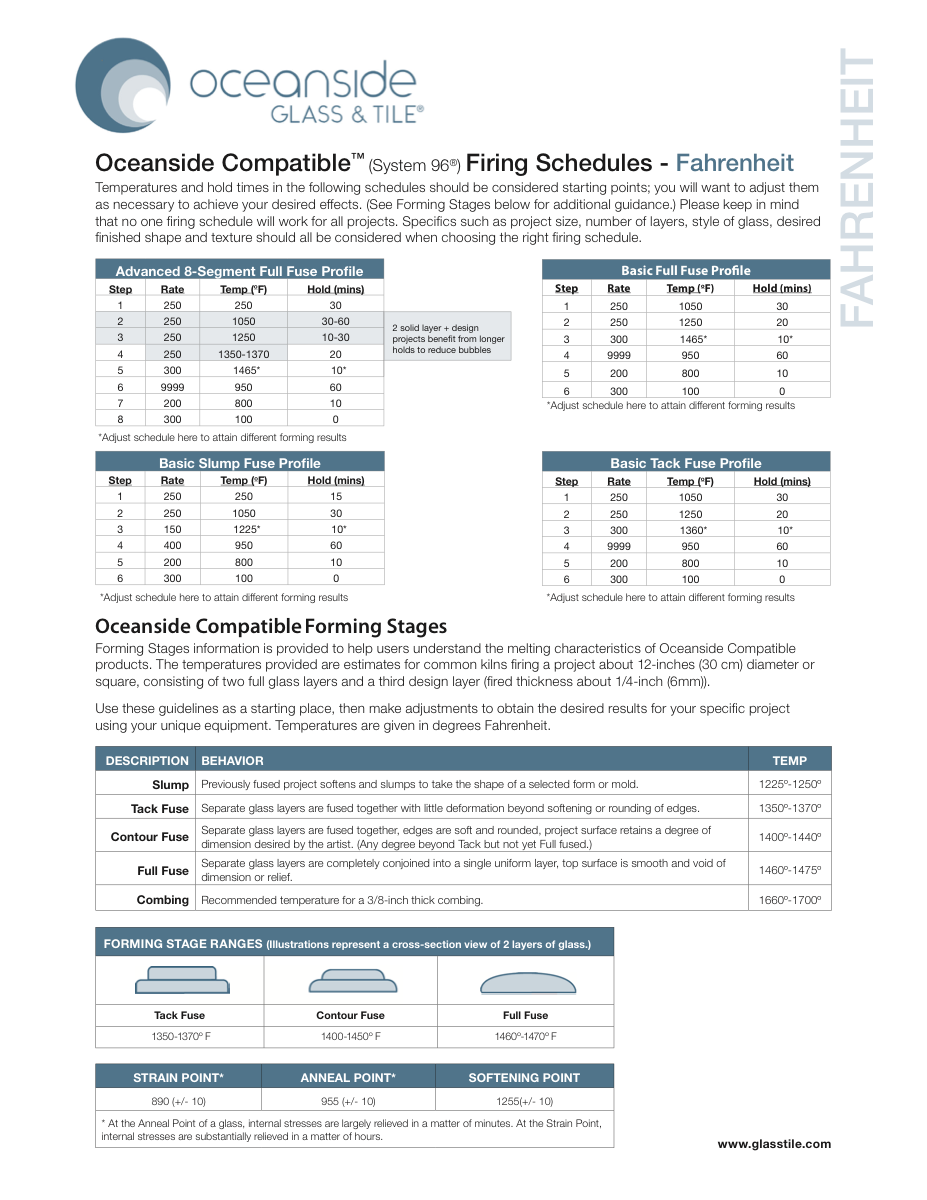
Learning those three words gives you a practical studio superpower. You can look at a schedule from Bullseye, Oceanside, Wissmach, a teacher, or a workshop handout and understand the basic intention before you ever enter numbers into a kiln controller.
The point is not to memorize perfect numbers. The point is to understand how a schedule communicates: move at this speed, aim for this temperature, then wait here long enough for a specific studio reason.
01 / Rate
Rate is the speed of temperature change.
Rate tells the kiln how quickly to heat or cool. Depending on the controller, it may be written as degrees per hour. A rate of 300°F per hour means the kiln should climb about 300 degrees in one hour if it can keep up.
Slower rates are used when the glass needs protection: early heat-up for thicker work, around sensitive temperature ranges, or during annealing and cooling. Faster rates can be useful when the glass is already past a fragile range or when the schedule needs to move efficiently toward a known target.
It helps to remember that the controller is giving an instruction, not a guarantee. A small kiln may follow a fast climb easily; a heavily loaded kiln may lag behind. The controller can ask for speed, but the kiln, load, shelves, molds, and room conditions all influence what actually happens.
This is why rate belongs in your firing notes. If two firings use the same target but one arrives there much more slowly, the glass may receive more total heatwork. That can change edge shape, surface texture, bubbles, and how deeply layers fuse together.
Rate answers: how quickly should the kiln move?
02 / Target
Target is the next temperature destination.
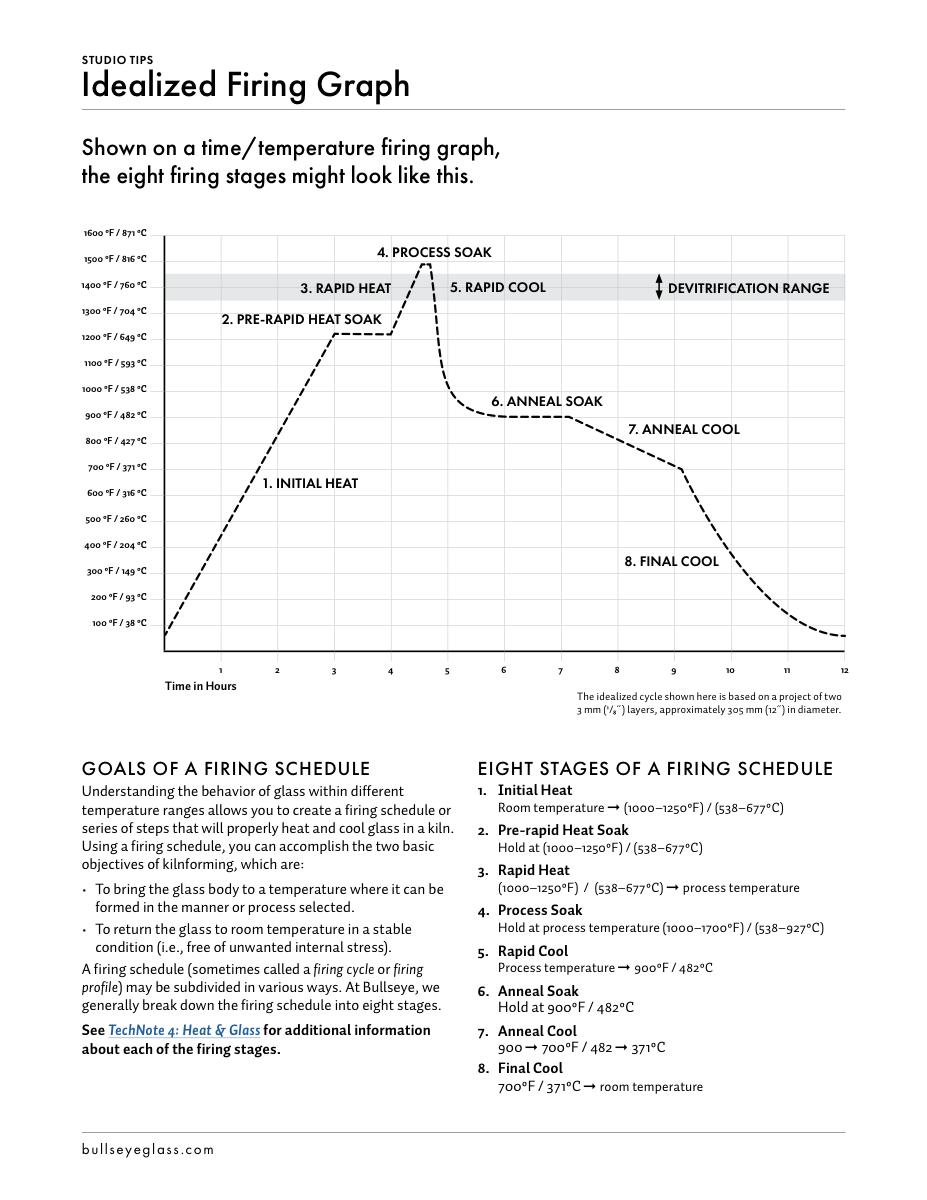
Target is the temperature the kiln is trying to reach at the end of the segment. A schedule may have several targets: a drying or preheat point, a bubble-squeeze point, a forming temperature, an anneal soak, and one or more controlled cooling points.
The target is not automatically the “result.” A full fuse, tack fuse, or slump depends on the target, the hold time, the glass, the kiln, the shelf setup, and the total heatwork leading up to that point.
Beginners often look for one magic target temperature for every result, but target temperatures are better understood as checkpoints. One checkpoint might be there to even out the load. Another might be there to let air escape. Another might be there to create the final visual change.
When you compare schedules, notice where their targets are similar and where they differ. Those differences often reveal the process: a schedule for slumping, tack fusing, full fusing, casting, or thick annealing is built around different destinations because the glass is being asked to do different jobs.
Target answers: where are we going next?
03 / Hold
Hold is time spent at a temperature.
Hold tells the kiln to pause at the target temperature. Holds let temperature even out across the glass, give bubbles time to move, allow glass to form, or give stress time to relax during annealing.
Longer is not always better. A longer hold at forming temperature can soften detail, round edges, over-slump a form, or trap a result you did not want. A longer anneal hold, on the other hand, may be exactly what a thicker or more complex piece needs.
A hold should have a reason. At lower temperatures, it might help the load equalize or allow moisture and binder materials to finish burning away. Around a bubble squeeze, it might give trapped air more opportunity to move. At forming temperature, it controls how far the glass relaxes, rounds, or flows.
The annealing hold is different because it is not about appearance. It is about stability. The piece may already look complete, but the hold gives internal temperature differences time to settle before the kiln begins the careful cool.
Hold answers: how long should the kiln wait here?
04 / Segment thinking
A schedule is a chain of decisions.
The real value comes from reading the three building blocks together. A segment that says “300°F/hour to 1100°F, hold 20 minutes” is not just three numbers. It says: move at a controlled speed to this checkpoint, then let the piece equalize before the next step.
That is the kind of reading that turns a borrowed schedule into a learning tool. Instead of copying blindly, you can identify the purpose of each move and decide whether it fits your piece, your kiln, and your desired result.
Segment thinking also makes changes safer. If you want less rounding, fewer bubbles, a deeper slump, or better annealing, you can adjust the segment most connected to that outcome. You do not have to rewrite everything at once.
The best studio notes connect the numbers to the result. Write down not only what you fired, but what each segment was meant to do. Over time, those notes become your own practical kiln language.
Do not memorize isolated numbers. Learn what each segment is trying to accomplish.
Studio notes
How to use this in the studio
Use these as practical prompts for a kiln log, a studio conversation, or your next firing test.
- Write rate, target, and hold in separate columns when copying schedules by hand.
- Add a “why” note beside each segment: warm-up, bubble squeeze, form, anneal, controlled cool.
- If a controller uses “full” or “AFAP,” still ask what range it is moving through and why that is acceptable.
- When troubleshooting, identify which segment most likely created the result you want to change.
Source references
Additional resources
One practical firing tip a week
Get a short glass-studio note in your inbox.
No spam — just one useful firing, glass, or studio-practice idea from My Glass Cookbook each week.
Your email is used for MGC studio notes. Read the Privacy Policy.