
Kiln schedules are usually written as tables, but glass experiences them as a journey. The controller sees rows and numbers. The glass feels rising heat, pauses, softening, forming, cooling, and stress relief over time.
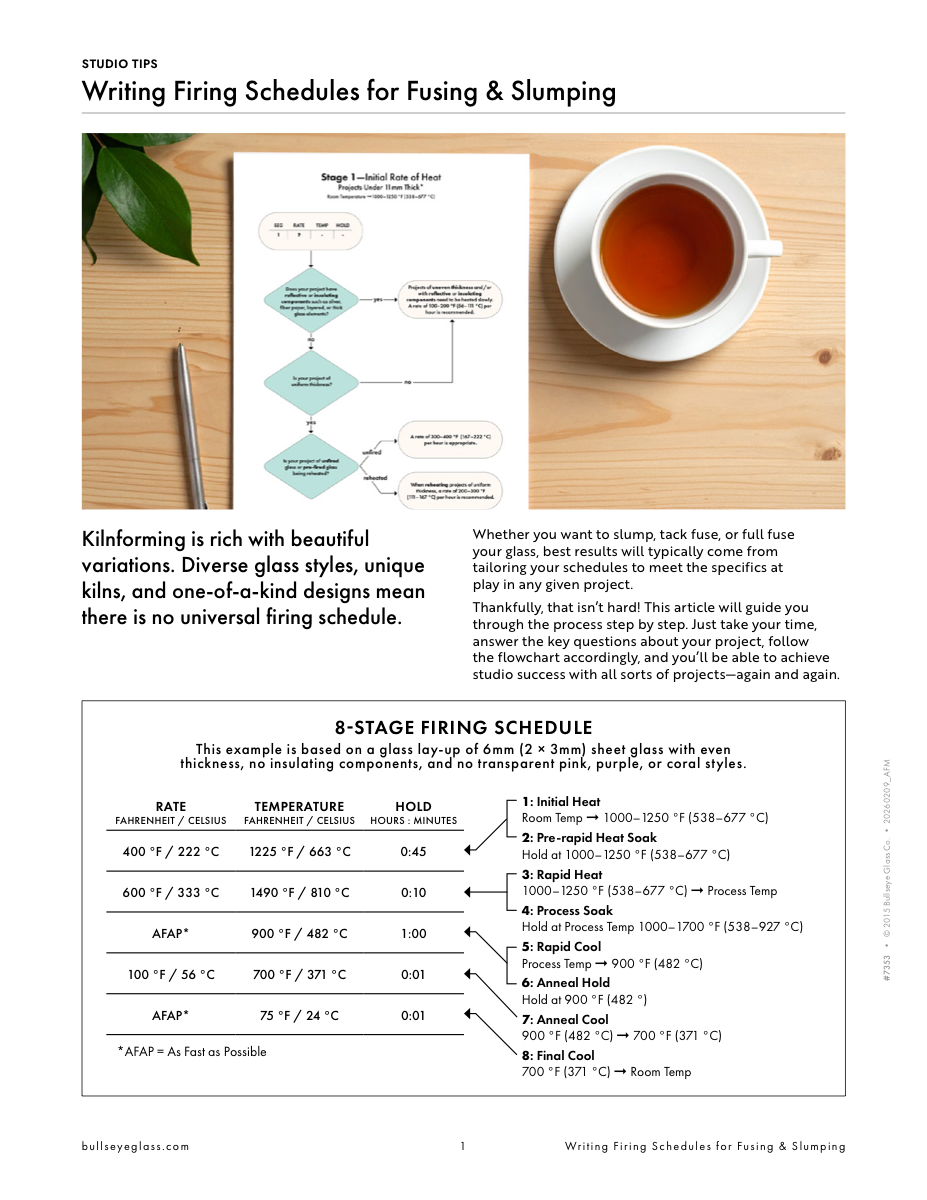
Reading a schedule like a map means translating the table into movement. Each row tells you how fast the kiln should move, where it is going next, and whether it should wait when it arrives. Once you can picture that path, the schedule becomes easier to understand and safer to adjust.
This skill is useful whether you use a digital controller, a printed manufacturer schedule, a teacher’s handout, or the Kiln Schedule Designer. You are learning to see the story behind the rows, not just copy the rows accurately.
01 / Start with direction
Ask whether the segment is climbing, holding, or cooling.
The first map-reading question is simple: what direction is the kiln moving? A segment can climb toward a higher target, hold steady at a target, cool toward a lower target, or cool under control through a sensitive range.
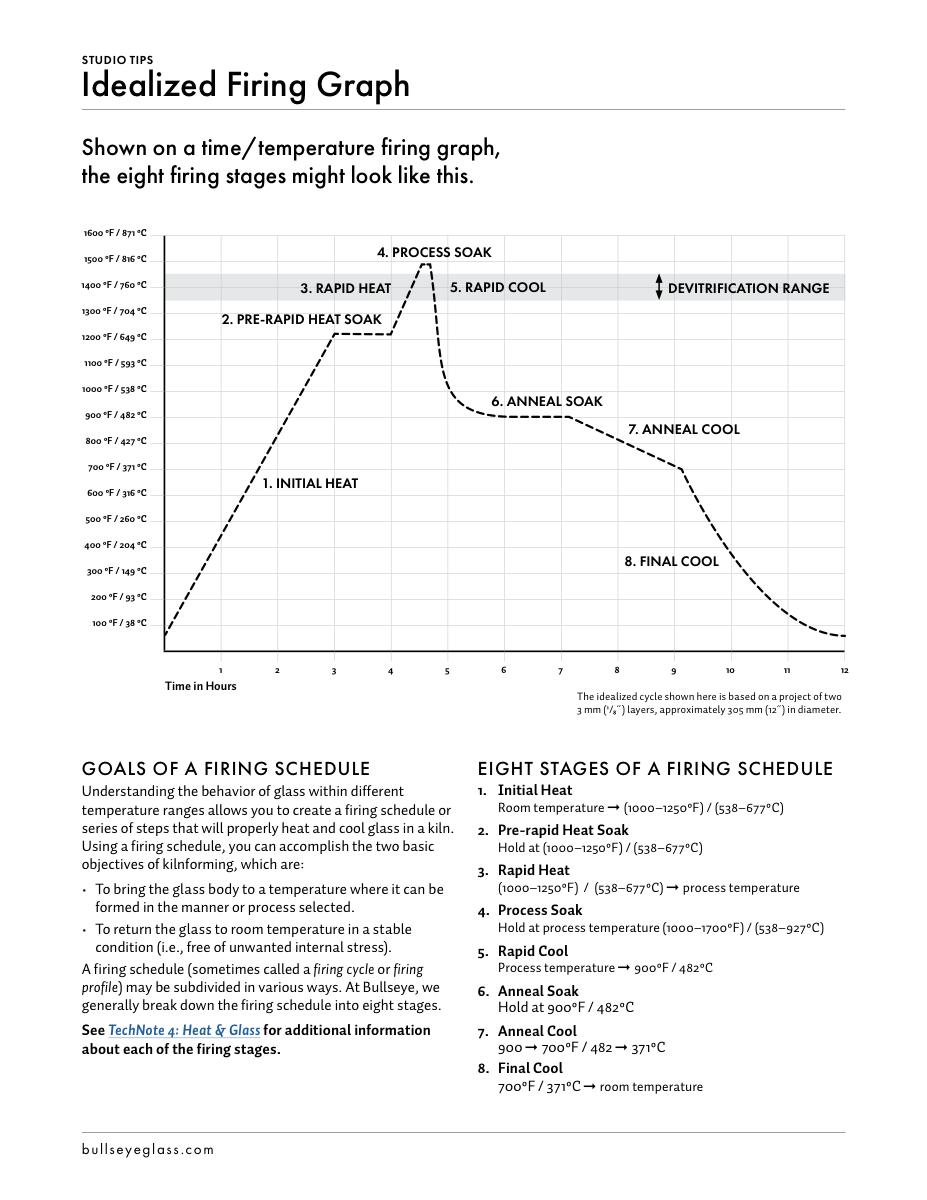
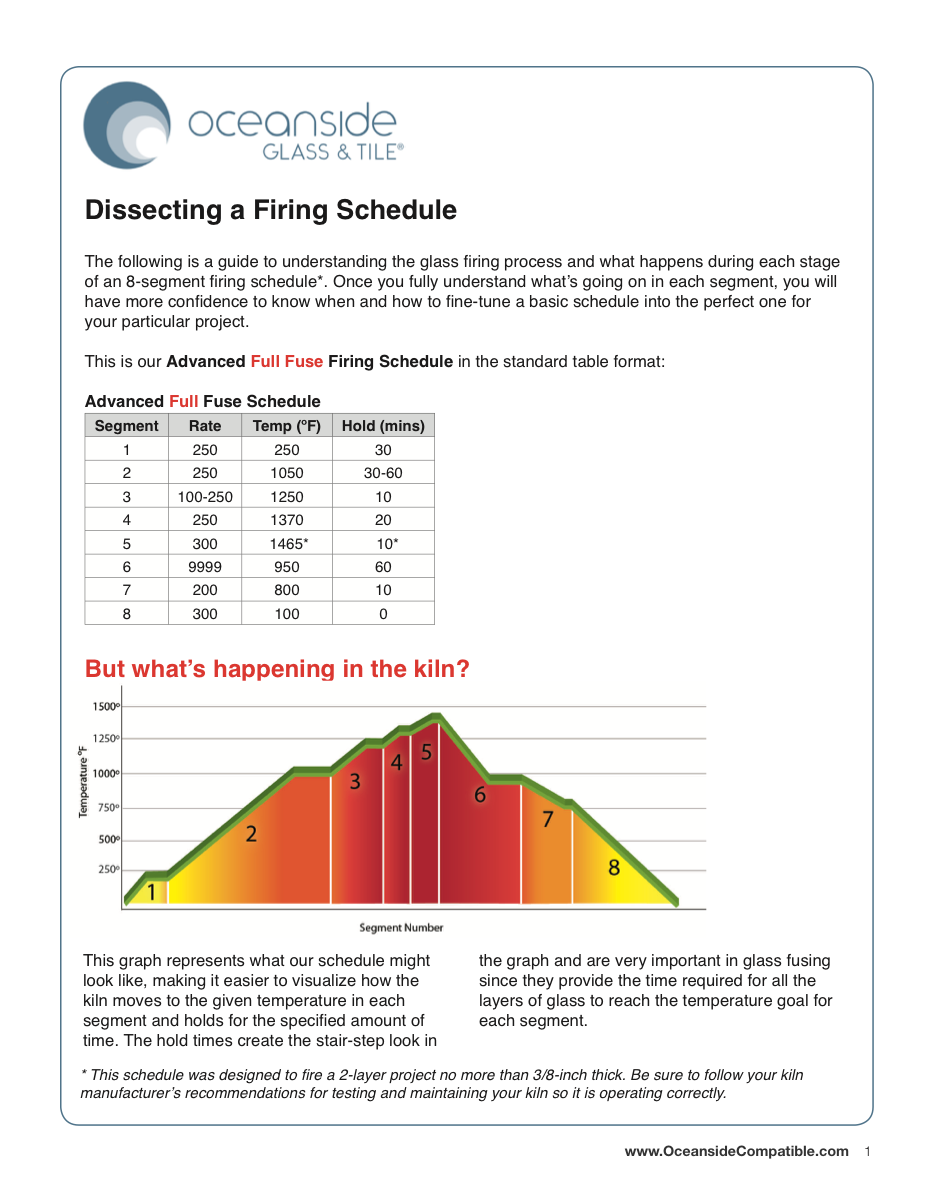
This immediately gives the table a shape. Climbing segments make the curve rise. Holds flatten it. Cooling segments make it fall. Controlled cooling through annealing is often the most important part of the downward path.
Once you see direction, you can read purpose. A slow climb may protect the glass. A hold may equalize temperature or let air move. A forming climb leads toward tack fuse, contour fuse, full fuse, slump, or another process. A controlled cool protects the piece after the visible result is done.
Do not rush past this step. Before entering numbers into a controller, read the schedule aloud in motion words: climb, pause, climb, form, drop, hold, cool. That translation catches mistakes and helps you understand the firing before it begins.
Map-reading habit: turn table rows into verbs before you turn them into controller entries.
02 / Notice the steepness
Rate controls the slope of the path.
On a graph, rate becomes steepness. A fast rate draws a steep line. A slow rate draws a gentler line. That visual idea helps explain why two schedules with the same target temperature can behave differently.
A steep early climb may be fine for small, simple work, but risky for thick or uneven pieces. A gentler climb gives the work more time to equalize. Around bubble squeeze or annealing, slope is often used deliberately to manage behavior rather than simply to save time.
The written rate is also an instruction, not proof that the kiln can physically follow it. A kiln may lag on a fast climb, overshoot a target, cool slower than requested, or behave differently when loaded with molds and shelves.
When you compare schedules, sketch the curve mentally. Which one climbs more steeply? Which one spends more time near forming temperature? Which one slows down through annealing? Those differences often explain why results change.
A rate is not just a speed; it is the slope of the glass’s heat journey.
03 / Read holds as reasons
Every pause should have a job.
A hold is where the curve flattens. That flat line can mean several different things depending on where it appears in the firing. It may equalize temperature, help air escape, give the glass time to form, or allow stress to relax.
The same word — hold — can therefore mean very different studio intentions. A hold near a bubble squeeze is not the same as a hold at forming temperature. An anneal hold is not about appearance at all; it is about internal stability.
When reading a schedule, write a short reason beside each hold. Equalize. Bubble squeeze. Form. Anneal. If you cannot name the reason, the hold may still be valid, but it deserves a closer look before you copy it into a different project.
This habit is especially useful when adjusting schedules. If you want fewer bubbles, you look at the hold connected to air movement and the construction around it. If you want less edge rounding, you look at the forming hold and total heatwork. If you want safer thick work, you look at annealing and cooling.
A hold is not empty time. It is where the schedule asks the glass to catch up, move, or relax.
04 / Mark the behavior zones
The map changes meaning as glass changes state.
A kiln schedule does not move through identical territory. At lower temperatures, the concern may be thermal shock, moisture, binders, and temperature equality. As glass softens, the concern shifts toward trapped air, edge movement, surface texture, and forming.
Near forming temperature, small changes can have visible effects. The glass may tack, contour, smooth, slump, stretch, or flow depending on time, temperature, thickness, gravity, and support. Later, as the kiln cools, the concern shifts again toward stress relief.
Marking these zones on the mental map helps you avoid treating every row the same. A fast segment may be safe in one zone and risky in another. A hold may be unnecessary in one project and essential in another.
This is where schedule literacy becomes studio judgment. You are no longer asking, “Is this the correct number?” You are asking, “What is the glass doing in this range, and does this segment support the result I want?”
The same curve line can mean protection, air movement, forming, or stress relief depending on where it sits.
05 / Use the map after firing
Troubleshooting starts by locating the result on the path.
After the firing, the map becomes a troubleshooting tool. If the piece has bubbles, look at construction and the bubble-squeeze area. If it is too flat, look at forming temperature, hold, and time spent near peak. If it cracked, look at heat-up, annealing, and cooling.
This does not mean every problem has only one segment. It means the schedule gives you a place to begin. Instead of changing everything, you can make a focused adjustment connected to the visible result.
A good kiln log strengthens the map. Record the schedule, the kiln, shelf position, glass type, thickness, mold, result, and what you would change. Over time, your notes become a personal atlas of how your kiln behaves.
The goal is not to become rigid. The goal is to make experiments more useful. When you can point to the part of the path that shaped the result, each firing teaches the next one.
The best schedule map is the one you mark up after the kiln opens.
Studio notes
How to use this in the studio
Use these as practical prompts for a kiln log, a studio conversation, or your next firing test.
- Before firing, summarize each segment with a verb: climb, hold, form, drop, anneal, cool.
- Draw a quick curve beside unfamiliar schedules so the shape becomes visible.
- Add a one-word reason beside each hold in your kiln log.
- After firing, connect the result back to the part of the curve most likely to have shaped it.
Source references
Additional resources
One practical firing tip a week
Get a short glass-studio note in your inbox.
No spam — just one useful firing, glass, or studio-practice idea from My Glass Cookbook each week.
Your email is used for MGC studio notes. Read the Privacy Policy.